Why Artist Collectives Are the Most Honest Thing Happening in the Art World Right Now
I want to tell you about a building in North Portland.
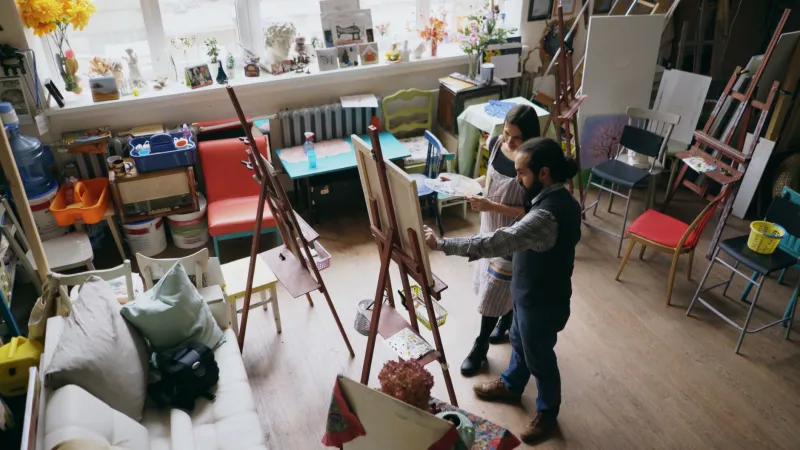
It used to be a printing warehouse. Now, on any given Tuesday evening, you might find a ceramicist teaching a free wheel-throwing workshop to teenagers from the neighborhood, a first-generation college student getting feedback on her portfolio from three working artists who volunteered their afternoon, and two painters arguing passionately — and affectionately — about whether a piece is finished or just scared.
This is Mudwork Collective. It is not affiliated with a museum. It has no major donor wall. Its operating budget would make a mid-sized gallery's accountant laugh. And it is, in my honest opinion, doing more for American art than most institutions ten times its size.
Artist collectives are having a moment — but more importantly, they're having an argument with the art world's power structures, and they're winning it.
The Gallery System and Its Discontents
Let's be real about what the traditional gallery model is and isn't. At its best, it connects artists with collectors, provides exhibition space, and creates a context for serious critical engagement with work. At its worst — which, frankly, describes a lot of it — it functions as a velvet-rope system that rewards artists who are already connected, already credentialed, already from money, or already famous.
The statistics are not subtle. A 2019 study by ArtNet found that just 25 galleries accounted for nearly half of all auction sales globally. The artists represented by those galleries skew overwhelmingly white, male, and trained at a small cluster of elite art schools. Women artists, artists of color, working-class artists, and artists outside major coastal cities are systematically underrepresented in the commercial gallery ecosystem.
This isn't a secret. It's not even controversial anymore. What's changed is that a growing number of artists have stopped waiting for the system to fix itself and started building alternatives.
What a Collective Actually Looks Like
The word "collective" covers a lot of ground. Some are formal legal entities with bylaws and membership dues. Others are loose confederacies of artists who share a studio building and a group chat. What they tend to have in common is shared infrastructure, mutual accountability, and a democratic — or at least collaborative — approach to decision-making.
Take Southside Makers in Birmingham, Alabama. Founded in 2017 by five artists who couldn't afford individual studio space, Southside has grown into a 22-member collective operating out of a former auto body shop. Members pay sliding-scale monthly dues that cover rent, materials storage, and shared equipment — including a laser cutter, a large-format printer, and a kiln that would be financially out of reach for any individual member.
"None of us could afford this alone," says founding member and printmaker Darnell Washington. "Together, we have a professional studio that's as well-equipped as anything in Atlanta. That changes what's possible."
But the material infrastructure is almost secondary to the social infrastructure. Southside holds monthly critique sessions that are, by all accounts, rigorous and honest. Members mentor newer artists. The collective curates its own group shows in the building's front gallery space — no application required, no gallerist deciding whose work is commercially viable enough to display.
"The critique I get here is better than anything I got in grad school," says painter and newer Southside member Kezia Osei. "Because these people know my whole practice. They've watched me work. They know when I'm playing it safe."
The Mentorship Gap — And How Collectives Fill It
One of the least-discussed problems in the traditional art world is the mentorship desert that most artists navigate after formal education ends. MFA programs provide community and feedback — and then graduation scatters everyone. The working artist, especially one who didn't land a teaching position or a prestigious residency, often finds themselves suddenly alone with their practice and without the support structure that helped them develop it.
Collectives, at their best, provide a permanent version of that structure. Not a two-year program with a tuition bill, but an ongoing community of practice that an artist can grow into and eventually give back to.
In Asheville, North Carolina, the Blue Ridge Makers Collective has formalized this through what they call a "studio lineage" model: experienced members are paired with emerging artists for year-long mentorship relationships, with both parties committing to regular studio visits, honest feedback, and collaborative goal-setting. More than sixty artists have moved through the program since 2018, and the collective tracks their progress — exhibitions, sales, grants received — with a transparency that most institutions would find uncomfortable.
"We want to know if this is actually working," says collective director Amara Singh. "Not just for us, but for the artists. Are people's careers moving? Are they making the work they want to make? If not, we need to change something."
The Exhibition Question
Here's where I'll make my most direct argument: artist-run exhibition spaces are producing some of the most interesting shows in the country right now, precisely because they aren't beholden to the market.
A commercial gallery has to think about what will sell. A museum has to think about donors, board members, and institutional reputation. An artist collective curates for an entirely different audience: the community it's embedded in, and the artists whose work it exists to support.
The result, at its best, is programming that takes risks a commercial gallery can't afford. Work that's formally experimental. Work that's politically uncomfortable. Work by artists who haven't yet built the kind of market track record that gets you a solo show at a Chelsea gallery.
In Kansas City, the Crossroads Collective — operating out of a series of connected storefronts in the city's arts district — has become known for its willingness to show work that challenges its audience. Their 2023 exhibition Debt, which featured work by artists grappling with student loan debt, medical debt, and generational poverty, was one of the most-attended shows in the collective's history. It also generated exactly zero commercial sales. The collective considers it one of their most successful exhibitions.
"Success for us isn't a sold-out show," says collective member and painter Rosa Jimenez. "It's a show that people come back to twice. That they bring their friends to. That they argue about on the way home."
This Isn't Anti-Art World — It's Pro-Artist
I want to be careful not to romanticize collectives into something they aren't. They have their own internal politics, their own exclusions, their own failures. Not every collective is democratic in practice. Not every mentorship relationship works. Some collectives are dominated by a few strong personalities and are, functionally, one person's fiefdom with better PR.
And the traditional gallery system, for all its flaws, has done genuine good — sustained careers, preserved work, connected artists with audiences they couldn't have reached alone.
The argument isn't that collectives should replace galleries. It's that the art world is healthier when there are multiple pathways — when an artist doesn't have to choose between playing the gallery game and making no living at all. Collectives expand the ecosystem. They create space for work and for people that the existing system systematically excludes.
Back in that Portland warehouse, the ceramicist is packing up her wheel. The teenagers are taking photos of their first wobbly bowls. The two painters have, apparently, decided the piece is finished after all.
This is what art looks like when it belongs to the people making it. I'll take it over a white-walled room every single time.