The Little Theaters That Could: 7 Small-Town Stages Where Live Performance Never Quit
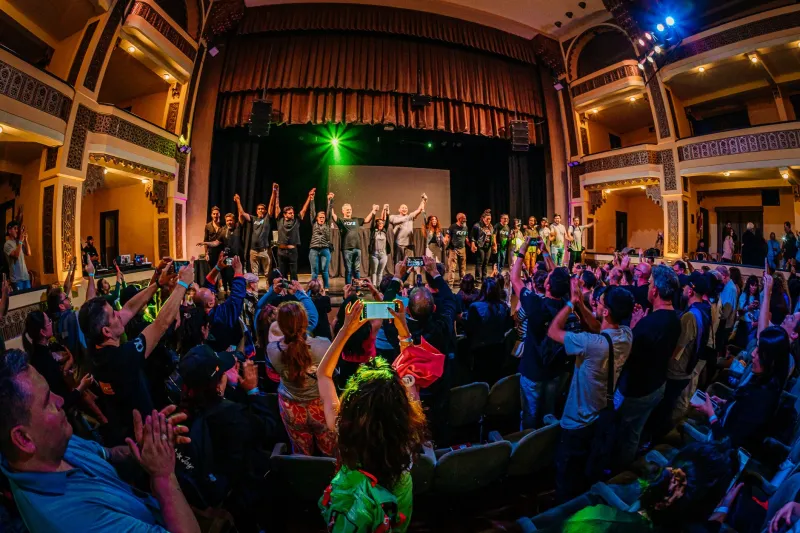
Somewhere in America tonight, a nervous actor is standing in the wings of a 200-seat house that has seen better days — the seats are a little worn, the lighting board is a relic, and the backstage bathroom situation is, let's say, a character-building experience. But the house is full. The audience knows half the cast personally. And when the lights go down, something happens that no algorithm can replicate.
Live theater in small-town America isn't dying. It's just doing it on a budget and on its own terms. Here are seven regional theaters that prove the point.
1. The Raven Theater — Galesburg, Illinois
Galesburg is a railroad town that has weathered more than its share of economic hard times, and The Raven Theater has been there for all of it. Founded in 1987 by a group of Knox College theater alumni who couldn't bear to leave, The Raven operates out of a converted grain warehouse on the edge of downtown.
The theater is best known for its annual Carl Sandburg Festival productions — Sandburg was born in Galesburg, and The Raven has built a cottage industry around theatrical adaptations of his poetry and prose. But their programming runs the full gamut, from edgy new American plays to a beloved summer musical that draws audiences from three counties over.
"This theater is what keeps a lot of people here," says longtime patron and volunteer Dorothea Mack. "When you can see something genuinely moving performed by people you know, in a building that's part of your history — that's not something you can get anywhere else."
The Raven has survived two near-closures, a roof collapse in 2011, and a global pandemic. At this point, the smart money is on The Raven.
2. Redtail Stage — Taos, New Mexico
Taos has always attracted artists, but Redtail Stage — founded in 2003 by director and playwright Elena Vigil — made a conscious choice to center Indigenous and Hispano New Mexican voices in ways that the town's art scene historically hadn't.
Operating out of a converted adobe building near the Taos Pueblo, Redtail produces three to four original works each season, most of them written or co-written by local playwrights. Their signature piece, Land and Blood, a multigenerational drama about a Tiwa family navigating land rights across three centuries, has been performed over 200 times and toured to six states.
The theater also runs an intensive youth program that has sent more than forty young people from Taos to theater training programs across the country. "We're not just making plays," Vigil has said. "We're making the next generation of storytellers."
3. The Millstone Playhouse — Harlan, Kentucky
Harlan County has been the subject of documentaries, protest songs, and political speeches, but it's rarely been the author of its own stories. The Millstone Playhouse, founded in 2009 by a coalition of Appalachian artists and educators, set out to change that.
Every production at Millstone is written by a playwright with roots in the region. The stories are unsparing — they deal with the opioid crisis, the decline of coal, the complicated pride of place that defines Appalachian identity — but they're told with a warmth and specificity that outside portrayals rarely manage.
"People come in expecting to see their hardship exploited," says artistic director Ben Combs. "They leave feeling seen. That's the whole job."
The Playhouse operates on a sliding-scale ticket model and has never turned anyone away for inability to pay. It is also, by most accounts, the social hub of Harlan on any given weekend.
4. Anchor Theater Collective — Marquette, Michigan
Up in Michigan's Upper Peninsula, winter is long and isolation is real. Anchor Theater Collective — a worker-owned theater company that launched in 2015 — was explicitly founded to give UP residents something to gather around when the cold sets in.
Anchor is notable for its devised theater practice: rather than staging existing scripts, the company builds productions collaboratively from community interviews, local history, and ensemble improvisation. Their 2022 production Ice Roads, about the communities that depend on frozen lake crossings to survive winter, was developed over eighteen months of community research and became one of the most-attended productions in the theater's history.
The cooperative ownership model means every company member has a vote in programming decisions — and a stake in the theater's survival. It's a model more regional theaters are watching closely.
5. Saguaro Rep — Bisbee, Arizona
Bisbee is the kind of town that attracts people who are fleeing something and end up finding something better. The former copper mining town near the Mexican border has, over the past few decades, become a magnet for artists, retirees, and free spirits — and Saguaro Rep, founded in 1998, is the cultural beating heart of that community.
The theater is known for its adventurous programming: they were staging queer theater in rural Arizona before it was anything close to fashionable, and their annual border-themed festival draws artists and audiences from both sides of the US-Mexico line.
"Bisbee doesn't do conventional," says Saguaro's longtime producing director, Marco Delgadillo. "So neither do we."
The theater operates out of a beautifully restored 1910 opera house and seats 175. It sells out regularly.
6. Prairie Wind Theater — Aberdeen, South Dakota
Aberdeen sits in the flat middle of South Dakota, equidistant from almost everything. Prairie Wind Theater, founded by a group of high school drama teachers in 1994, started as a summer program for teenagers and grew into one of the most respected regional companies in the northern plains.
Their specialty is new American musicals — they've developed and premiered more than a dozen original works over the years, several of which have gone on to productions at larger regional theaters. Prairie Wind has become an unlikely incubator, in part because the distance from the coasts gives artists room to take risks without the pressure of industry scrutiny.
"Nobody from New York is flying out here to review us," laughs artistic director Susan Holmberg. "That's terrifying and completely liberating at the same time."
7. The Foxhole Theater — Hattiesburg, Mississippi
Founded in the aftermath of Hurricane Katrina by a group of displaced New Orleans theater artists who ended up in Hattiesburg and never left, The Foxhole is a study in making something out of loss.
The theater operates out of a former auto repair shop — the original pit is still in the floor, now covered with a removable stage — and produces work that reflects the Gulf South in all its complexity: the music, the food, the racial history, the faith, the floods.
The Foxhole's annual production of an original Mardi Gras musical has become a regional institution, drawing audiences from across Mississippi and Louisiana. More quietly, the theater's after-school program has served hundreds of kids in one of the state's lower-income school districts.
"Theater saved some of us after the storm," says co-founder and director Tamika Broussard. "So now we try to pay that forward every single season."
Why It Matters
These seven theaters are not outliers. They're part of a vast, undercelebrated network of regional and community stages that sustain live performance in places the mainstream theater industry doesn't think about much. They do it with bake sales and benefit concerts and boards of directors made up of hardware store owners and retired teachers and passionate believers in the irreplaceable thing that happens when live humans perform for a room full of other live humans.
That thing — that unrepeatable, unstreaming, you-had-to-be-there thing — is worth protecting. It turns out a lot of small towns already know that.