When Art Becomes Medicine: 5 Community Programs Using Creativity to Rebuild Lives From the Inside Out
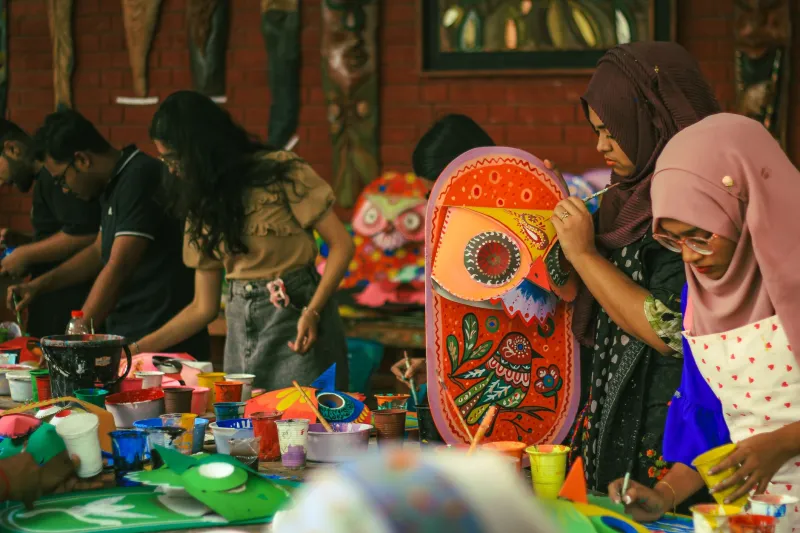
Somewhere in a juvenile detention facility in New Orleans, a sixteen-year-old is writing a poem about his grandmother's kitchen. In a veterans' center in Portland, a woman who spent twelve years in the Marines is mixing paint colors she's never tried before, her hands steadier than they've been in months. In a community studio on the south side of Minneapolis, a group of survivors are making collages out of magazine pages and old photographs, laughing at something one of them just said.
None of these people would describe themselves as artists. And yet, in each of these moments, something is happening that clinical language struggles to capture — something that looks a lot like healing.
Art therapy and community creative programs have existed in various forms for decades, but a new generation of grassroots initiatives is pushing the model further and making it more accessible, more culturally responsive, and more deeply embedded in the communities they serve. Here are five programs doing that work with remarkable results.
1. Precious Blood Ministry of Reconciliation — Chicago, Illinois
From Violence to Vision
In the Englewood and Back of the Yards neighborhoods on Chicago's South Side, Precious Blood Ministry of Reconciliation has been doing violence interruption work for years. But at the heart of their approach is something that might surprise you: art.
Their Circle programs bring together young people who have been directly impacted by community violence — as witnesses, as victims, sometimes as perpetrators — and use creative expression as a pathway into deeper conversation and healing. Participants paint, write, perform, and build. They create work that reflects their actual lives, not sanitized versions of them.
What makes this program distinct is its refusal to treat art as a feel-good add-on. Here, it's central to the therapeutic and restorative process. Staff members trained in trauma-informed care work alongside artists to create an environment where making something becomes a way of saying what can't otherwise be said.
The results, tracked over time, show meaningful reductions in re-arrest rates among participants — and more importantly, young people who describe feeling seen and capable in ways they hadn't before.
Want to replicate it? Start by partnering with existing violence prevention organizations in your city rather than building from scratch. Bring in local artists who have lived experience in the communities they're serving. Trauma-informed training for everyone involved is non-negotiable.
2. The Prison Arts Coalition — National Network
Creating Inside the Walls
The United States incarcerates more people than any other nation on earth. Inside those facilities, access to creative programming is increasingly rare — and increasingly essential. The Prison Arts Coalition, a national network that connects and advocates for arts programs inside correctional facilities, is working to change that.
Member programs range from painting and drawing workshops to full theater productions staged by incarcerated performers for audiences that include correctional staff, family members, and community members. The Shakespeare Behind Bars program, operating in multiple states, has produced research showing dramatically lower recidivism rates among participants compared to the general incarcerated population.
The mechanism isn't mysterious. When someone creates something — a painting, a monologue, a song — they are exercising agency and imagination in an environment specifically designed to deny both. They are practicing empathy by inhabiting characters or perspectives beyond their own. They are building skills, relationships, and a sense of self that persists after release.
Want to replicate it? Contact your state's Department of Corrections about volunteering as an arts facilitator. Organizations like the William James Association offer training and support. Persistence matters — prison bureaucracies move slowly, but the need is enormous and the impact is real.
3. Youth Theater Eastside — Austin, Texas
Staging New Possibilities
Youth Theater Eastside works with young people from Austin's historically underserved east side communities, using theater as a tool for social-emotional learning, academic engagement, and community connection. Participants — ranging in age from eight to eighteen — write, direct, and perform original plays that draw on their own experiences and concerns.
What's remarkable about YTE's model is how seriously it takes young people's voices. These aren't adults writing scripts for kids to perform. These are kids developing their own stories, with adult mentors who help shape and support the work without taking it over. The result is theater that is genuinely surprising, sometimes raw, and consistently powerful.
Long-term participants show improved school attendance, stronger conflict resolution skills, and — perhaps most significantly — a more robust sense of their own capacity to affect the world around them. That last thing, that sense of agency, is what trauma so often destroys. Theater, it turns out, is one way to rebuild it.
Want to replicate it? Connect with the American Alliance for Theatre and Education (AATE) for resources and community. Look for local theater professionals willing to donate time. School partnerships can provide space and built-in audiences. Start with a summer intensive to test the model before committing to year-round programming.
4. The Art Therapy Project — New York City
Processing the Unprocessable
Founded in the aftermath of 9/11 to support survivors and first responders, The Art Therapy Project has evolved into a community mental health organization offering free art therapy services to trauma survivors across New York City. Their model is built around the understanding that trauma lives in the body and in the images the mind makes — and that making art is one of the most direct ways to access and transform both.
Clients include domestic violence survivors, refugees, veterans, and people dealing with the long tail of grief. Sessions are led by credentialed art therapists who understand that the therapeutic goal isn't a beautiful finished product — it's the process of making, the choices, the surprises, the moments of recognition that happen when an image appears on paper that you didn't know you were carrying.
The waitlist for their services is long. That's the heartbreaking part. But their model is documented, their outcomes are tracked, and they actively support other organizations trying to build similar programs.
Want to replicate it? Credentialed art therapists are essential — this isn't a program that can be run by well-meaning volunteers alone. The American Art Therapy Association (AATA) maintains a directory and can connect you with professionals in your area. Seek funding through mental health grants rather than arts grants — this framing often opens different doors.
5. Roots. Community Health — Oakland, California
Healing at the Intersection of Art and Justice
Roots. Community Health describes itself as a "healing justice" organization, and that framing tells you something important about how they approach creative programming. For them, art isn't separate from the work of addressing systemic inequity — it's part of the same practice.
Their creative wellness programs serve Black and brown communities in Oakland and the surrounding Bay Area, with offerings that include mural projects, spoken word, movement, and community storytelling. Everything is designed to be culturally grounded — rooted in the specific histories, aesthetics, and ways of knowing that participants bring with them.
The explicit acknowledgment that trauma in these communities is often collective and systemic — not just individual — sets this program apart. Healing, here, is understood as both personal and political. And the art reflects that complexity.
Want to replicate it? Cultural responsiveness isn't an add-on — it has to be built in from the beginning. That means hiring staff who share lived experience with participants, compensating community members for their knowledge and labor, and being willing to be led by the community rather than leading it.
The Bigger Picture
What connects all five of these programs — beyond paint and stage lights and shared space — is a fundamental conviction: that every person has something worth expressing, and that the act of expression itself is healing. Not as metaphor. As practice.
In a country carrying as much collective grief and unprocessed trauma as ours, that conviction isn't a luxury. It's a necessity. And the communities building these programs, often with minimal resources and maximum heart, are showing the rest of us what's possible.
At Bonnie Clac, we believe art and community aren't separate things. Stories like these are why.
Is there a community art therapy program in your area that deserves a spotlight? We'd love to hear about it.